A crowded lobby that feels warm at 9 a.m., a server room with rising temperatures, or a restaurant dining area that never cools down can quickly become an operational problem. Knowing how to prepare commercial HVAC equipment before peak weather arrives helps protect employee comfort, customer experience, inventory, and your budget. For businesses in Monroe and the Charlotte area, preparation should begin before summer heat or a winter cold spell places your equipment under its heaviest load.
Commercial HVAC preparation is more than replacing a filter when someone notices an issue. It is a planned review of the equipment, airflow, controls, and maintenance records that keep a building comfortable day after day. The exact plan depends on your building type, occupancy, operating hours, and equipment, but a few priorities apply to nearly every facility.
How to Prepare Commercial HVAC Before Peak Demand
The best time to address an HVAC concern is when the system can be taken offline briefly without disrupting your business. Waiting until the first 90-degree week or the first hard freeze may mean longer repair timelines, higher strain on equipment, and less flexibility for your staff.
Start by reviewing the previous season. Look at service invoices, employee or tenant complaints, utility costs, and any recurring trouble spots. A unit that needed repeated refrigerant service, tripped breakers, produced uneven temperatures, or struggled to reach the thermostat setting deserves attention before it is asked to run continuously.
This review also helps set priorities. A small comfort issue in a lightly used storage area may be manageable for a short time. Poor cooling in a customer-facing space, kitchen, medical office, data room, or occupied office suite is more urgent. Facility managers should share these operational details with their HVAC technician so the service plan reflects how the building actually functions.
Schedule a professional inspection early
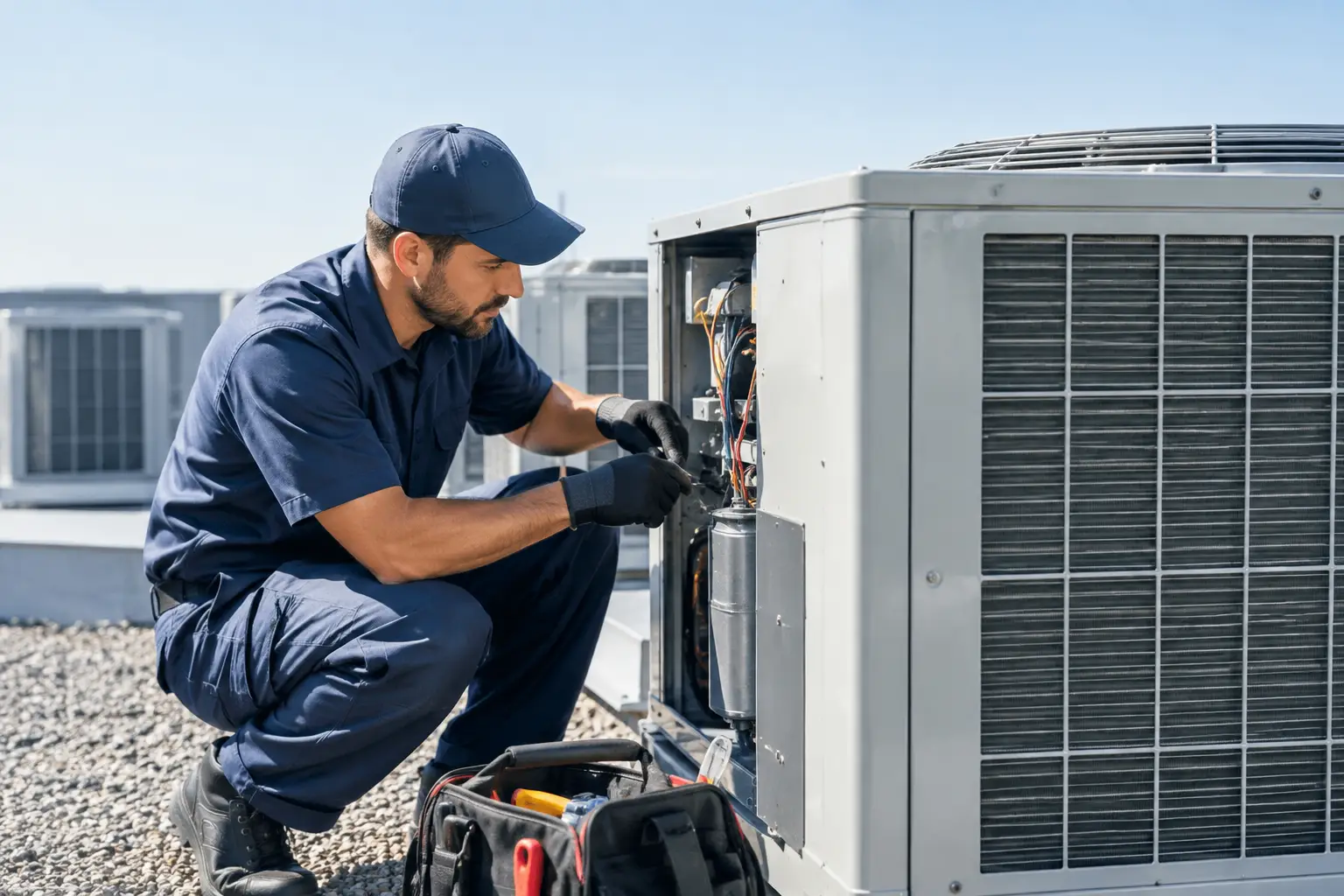
A professional commercial maintenance visit gives you a clearer picture of equipment condition than a visual walk-through alone. Your technician can inspect rooftop units, split systems, heat pumps, air handlers, exhaust equipment, thermostats, and related components that may not be accessible to building staff.
During seasonal service, a technician typically checks electrical connections, motors, belts where applicable, safety controls, refrigerant performance, condensate drainage, and system operation. They can also clean components that restrict heat transfer, identify worn parts, and verify that the unit starts, runs, and shuts down correctly.
Early scheduling matters because it creates time to make informed decisions. If a contactor, capacitor, blower motor, belt, thermostat, or control component is nearing failure, replacing it during planned maintenance is often less disruptive than responding to a no-cooling or no-heating call during business hours. If a larger repair or replacement is recommended, you have time to compare options and plan around your operating schedule.
Start With Airflow and Filtration
Airflow is one of the most common reasons a commercial system falls behind. When air cannot move freely through the system, equipment works harder while delivering less comfort. That can lead to hot and cold zones, higher energy use, frozen coils, poor humidity control, and unnecessary wear.
Make filter replacement part of a written schedule rather than a reaction to visible dirt. The right interval varies. A low-traffic office may have different needs than a retail store, warehouse, restaurant, medical practice, or facility near active construction. Higher-efficiency filters can improve particle capture, but they must be properly sized for the equipment. A filter that is too restrictive for the system can reduce airflow and create its own performance problems.
Ask your HVAC professional to confirm the correct filter type, size, and replacement frequency for each unit. Label filters and keep a simple log with replacement dates. This small step makes it easier to spot patterns, especially in properties with multiple units or tenant spaces.
Airflow also depends on supply vents, return grilles, ductwork, and dampers. Furniture, displays, stored boxes, and tenant alterations can block return air paths without anyone realizing it. Walk the building and make sure vents are open and unobstructed. If certain rooms remain uncomfortable, do not assume the thermostat is the only issue. Damaged ductwork, disconnected sections, poor balancing, or inadequate return air may be involved.
Check Outdoor Units, Drains, and Electrical Components
For rooftop and outdoor equipment, clear access is a practical part of preparation. Leaves, pollen, trash, landscaping growth, and other debris can build up around condenser coils and restrict airflow. Coils should be professionally cleaned using methods appropriate for the equipment. Bending fins or using excessive pressure can reduce performance rather than improve it.
Condensate drains deserve the same attention. In North Carolina’s humid weather, a clogged drain line or pan can lead to water damage, shutdowns, odors, and indoor humidity problems. If your staff has noticed water near an indoor unit, staining around ceiling areas, or musty smells, address it before cooling season is fully underway.
Electrical components should only be inspected and serviced by qualified professionals. Commercial HVAC systems rely on wiring, disconnects, capacitors, relays, contactors, and controls that must operate safely under heavy demand. Warning signs such as frequent breaker trips, intermittent operation, humming, burning odors, or units that start and stop repeatedly call for prompt service. Continuing to reset a breaker or force a unit to run can turn a manageable repair into a larger equipment failure.
Confirm Thermostats, Schedules, and Building Controls
An HVAC system cannot perform efficiently if its controls do not match the building’s schedule. Before the season changes, review thermostat settings, programmed occupancy times, temperature setbacks, and override permissions. Businesses often change hours, add staff, renovate space, or adjust workflows without updating their HVAC controls.
For example, a system programmed for an 8 a.m. opening may not have enough lead time to cool a busy gym, retail store, or office by the time employees and customers arrive. On the other hand, running equipment at full capacity in an empty building all night wastes energy. The right schedule balances comfort with operating cost.
It also helps to verify that thermostats are reading accurately and are located appropriately. A thermostat exposed to direct sunlight, supply air, cooking equipment, or a constantly opened exterior door may not represent the temperature in the rest of the space. Zoned buildings need added attention because one improperly operating zone can affect comfort across an entire floor.
Prepare for Problems Without Waiting for One
Even well-maintained equipment can develop unexpected issues. A practical commercial HVAC plan includes clear instructions for who can approve service, who should be contacted after hours, where equipment records are kept, and how to respond if a critical space loses heating or cooling.
Keep model and serial numbers, maintenance records, warranty information, and a list of known equipment locations in one accessible place. For multi-tenant properties, establish a process for reporting comfort concerns with details such as the location, time of day, thermostat setting, and whether the issue is constant or intermittent. Specific information helps a technician diagnose the problem faster.
Consider the consequences of a failure in each area of your facility. A short interruption in a conference room may be inconvenient, while a temperature issue in a computer room, food storage area, healthcare setting, or production space may require immediate action. Planning for those differences helps you respond calmly and protect operations.
Know When Repair Gives Way to Replacement
Preparation sometimes reveals that a system is approaching the end of its useful service life. Age alone does not determine whether replacement is necessary. A well-maintained unit may continue to serve a business reliably, while a newer unit with repeated major failures may deserve closer evaluation.
The decision usually comes down to repair frequency, energy performance, equipment condition, availability of parts, and the cost of disruption if the unit fails. A professional assessment can help you compare the near-term cost of repair with the long-term value of replacement. For planned upgrades, PR Mechanical can explain the options clearly so your business can choose a solution that fits its space, budget, and operating needs.
Comfort problems rarely stay isolated for long. Preparing your commercial HVAC system now gives your team more control over cost, scheduling, and the comfort people notice the moment they walk through your doors.