A room can feel cool or warm enough and still leave people sneezing, coughing, waking with headaches, or noticing a stale odor every afternoon. In North Carolina, high humidity, long cooling seasons, pollen, pet dander, and tightly closed windows can all affect what circulates indoors. This air quality testing guide explains when testing makes sense, what it can reveal, and what to do with the results.
When indoor air quality testing is worth it
Testing is most useful when there is a clear concern, not simply because a homeowner wants a number to watch. Repeated allergy-like symptoms that improve when someone leaves the building, persistent musty odors, visible moisture, recent water damage, unusual dust buildup, and rooms with uneven humidity are all reasonable reasons to investigate.
For businesses, the stakes can be broader. A stuffy office, odors near a break room or restroom, complaints from employees, or humidity in a storage area can affect comfort, productivity, inventory, and customer experience. Testing can help narrow down whether the issue is related to ventilation, filtration, moisture, cleaning products, building materials, or another source.
A test is not always the first step. If there is a known problem such as a leaking roof, a wet crawlspace, a backed-up drain, or a damaged duct, address the source promptly. Testing may help document conditions or guide the repair, but it cannot substitute for correcting active moisture or ventilation problems.
What an air quality test can measure
Indoor air quality is not one measurement. The right test depends on the concern and the building. A professional assessment may include a combination of observations, HVAC checks, moisture readings, and targeted sampling.
Particles and allergens
Particle testing measures airborne material such as dust, pollen, smoke, and fine particles that can move deep into the lungs. These readings may rise during wildfire smoke events, heavy pollen periods, nearby construction, cooking, or when an HVAC filter is overdue for replacement.
Particles do not identify every allergen or tell you exactly where dust came from. They can, however, show whether filtration and air movement are reducing airborne debris effectively. A properly sized, regularly changed filter is often one practical part of the solution, but using the highest-rated filter available is not always best. Some systems cannot handle overly restrictive filters without reduced airflow and added strain.
Humidity and moisture
Humidity is one of the most useful measurements in the Charlotte-area climate. Indoor relative humidity that stays high can support mold growth, dust mites, and musty odors. Humidity that is too low can contribute to dry skin, irritated sinuses, and static electricity, though excessively dry indoor air is less common during much of our cooling season.
A single humidity reading only captures one moment. A technician may look for patterns by checking different rooms, supply vents, return areas, crawlspaces, and locations near exterior walls. High humidity can point to an oversized air conditioner that short-cycles, an improperly operating system, duct leakage, inadequate ventilation, or moisture entering through the building envelope.
Carbon dioxide and ventilation indicators
Carbon dioxide, or CO2, is often used as a ventilation indicator in occupied buildings. It is not usually a direct health hazard at the levels found in a typical home or office, but elevated readings can suggest that fresh-air exchange is limited for the number of people using a space.
This matters particularly in conference rooms, classrooms, waiting areas, and offices with many people in a small area. Results should be interpreted with the building’s occupancy, HVAC design, and the time of day in mind. A reading collected in an empty room will not tell the same story as one taken during a full staff meeting.
Volatile organic compounds
Volatile organic compounds, commonly called VOCs, are gases released from products and materials. Fresh paint, new flooring, furniture, aerosol sprays, cleaning supplies, fragrances, stored gasoline, and some hobby materials can contribute to VOC levels.
A VOC test can identify whether elevated levels are present, but it may not identify every specific chemical source. The timing of the test matters. If a room was painted yesterday or cleaned heavily an hour before sampling, the reading could be temporarily higher than its usual condition. Good testing considers those recent activities rather than treating a result as a final diagnosis.
Carbon monoxide
Carbon monoxide, or CO, deserves separate attention. It is colorless, odorless, and potentially life-threatening. Fuel-burning furnaces, fireplaces, water heaters, generators, and vehicles can create a risk when combustion equipment is malfunctioning or poorly vented.
Every home and business with fuel-burning equipment should have working carbon monoxide alarms in appropriate locations. If an alarm sounds, or anyone experiences dizziness, nausea, confusion, chest pain, or severe headache and CO is suspected, get people outside immediately and call 911 or the fire department. Do not wait for a routine HVAC appointment or reenter until emergency responders say it is safe.
DIY monitors versus professional testing
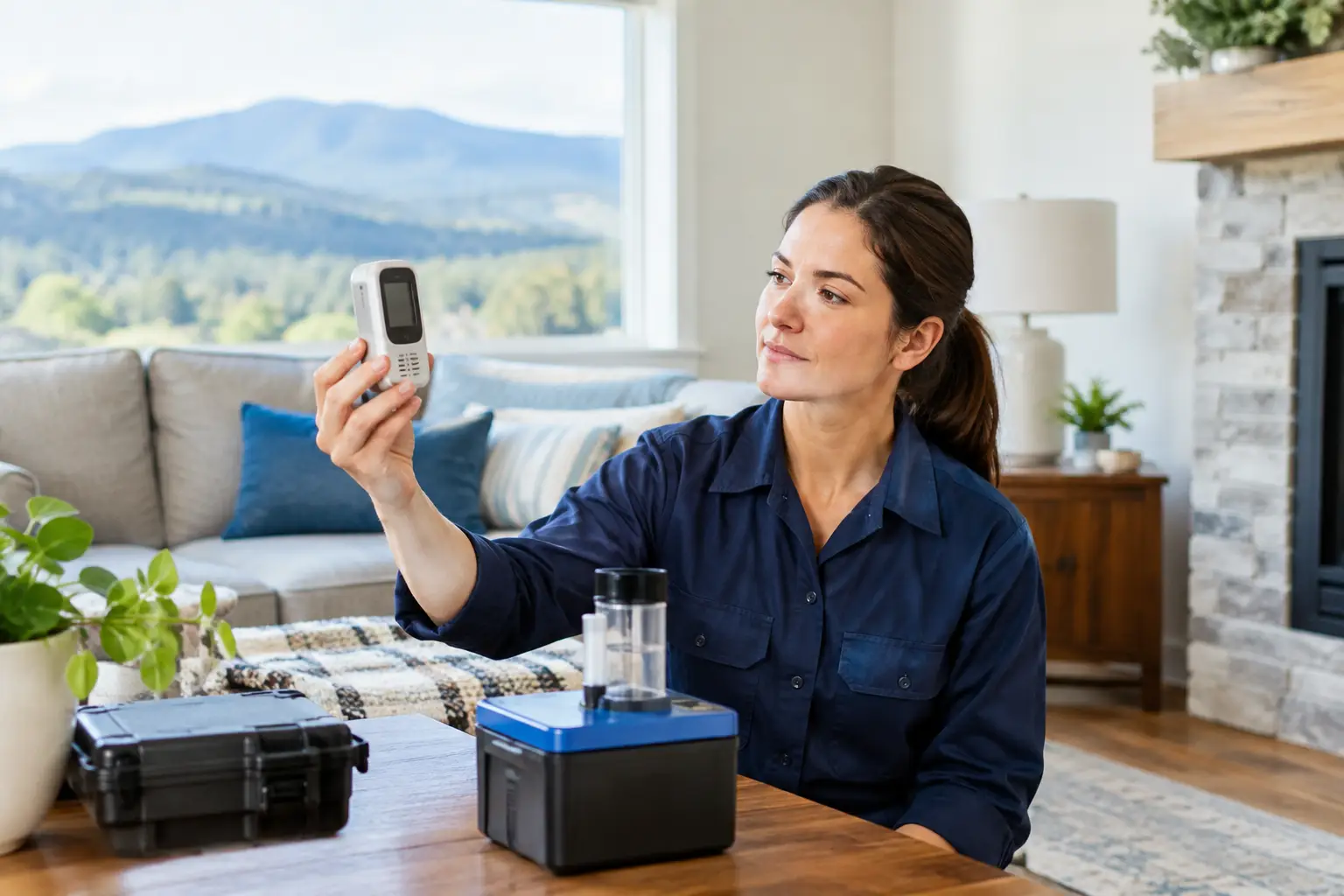
Consumer air monitors can be helpful for spotting trends. A monitor that tracks humidity, fine particles, or CO2 may show that conditions worsen while cooking, when the HVAC system runs, or in a particular room. That information can help a homeowner or facility manager describe the problem more clearly.
Still, low-cost monitors have limits. Sensors can drift, placement affects readings, and many devices provide broad estimates rather than laboratory-grade measurements. Placing a monitor beside a supply vent, open window, kitchen range, or bathroom can create a reading that does not represent the entire room.
Professional testing is a better choice when symptoms persist, moisture or mold is suspected, a commercial facility has repeated comfort complaints, or results may influence a repair decision. The goal is not to collect the most data. It is to identify the source of the concern and choose a fix that will hold up over time.
How to prepare for an indoor air quality assessment
Before testing, write down what you have noticed. Include where the issue occurs, when it started, whether it changes after rain or during HVAC operation, and whether people feel better away from the building. Note recent renovations, new furnishings, water events, pest treatments, or changes in cleaning products.
Avoid trying to mask the issue beforehand. Strong air fresheners, heavy cleaning, scented candles, and open windows can alter some readings. Follow the testing provider’s instructions, since preparation depends on the type of assessment being performed.
It also helps to have basic HVAC details available: the age of the system, filter type and replacement schedule, recent repairs, thermostat settings, and any rooms that are consistently too humid, dusty, hot, or cold. Those details often connect air quality concerns to airflow, filtration, ductwork, or equipment performance.
Understanding the results without jumping to conclusions
A test result is a clue, not always a verdict. Indoor conditions naturally vary with weather, occupancy, cooking, cleaning, pets, and outdoor pollen. One elevated particle reading may reflect dinner being prepared. Consistently elevated readings in a bedroom, on the other hand, call for a closer look at filtration, carpets, pets, outdoor air entry, and cleaning practices.
Mold testing requires particular care. Finding mold spores in an air sample does not automatically prove that there is hidden mold growth, and a normal sample does not rule out moisture behind a wall or under flooring. Visible mold, a recurring musty smell, or confirmed water intrusion should lead to moisture-source correction first. If significant contamination is present, qualified remediation may be needed before HVAC cleaning or improvements are considered.
The most useful reports connect findings to a practical plan. That plan might include repairing duct leaks, improving drainage around the property, correcting a condensate issue, adjusting equipment operation, installing appropriate filtration, adding dehumidification, or improving ventilation. The right answer depends on the building, not on a one-size-fits-all product recommendation.
Use testing to improve the system, not just the number
Good indoor air quality is tied to the full comfort system. Clean filters, properly sealed ducts, balanced airflow, dependable drainage, correct refrigerant performance, and regular maintenance all play a role. A portable purifier may help in a specific room, but it will not solve humidity from a failing system or contaminants entering through a return duct in an unconditioned space.
For homes and businesses in Monroe and the greater Charlotte area, a qualified HVAC professional can evaluate how the system is affecting the air people breathe. PR Mechanical can help connect air quality concerns with clear, practical HVAC solutions, without adding unnecessary complexity.
The best next step is usually simple: pay attention to recurring patterns, address obvious moisture or safety issues quickly, and use testing when it will help identify the real cause. Cleaner, more comfortable air starts with an informed decision and a solution matched to the space.